
Leadership Accountability: Scoring Executive Presence and Insider Buying Together
Buy-side diligence teams have no repeatable way to catch a management team quietly checking out before a miss — LacunaIndex's Leadership Accountability scoring cross-references public presence (calls, conferences, press, LinkedIn) with Form 4 insider-buying patterns to flag it early.
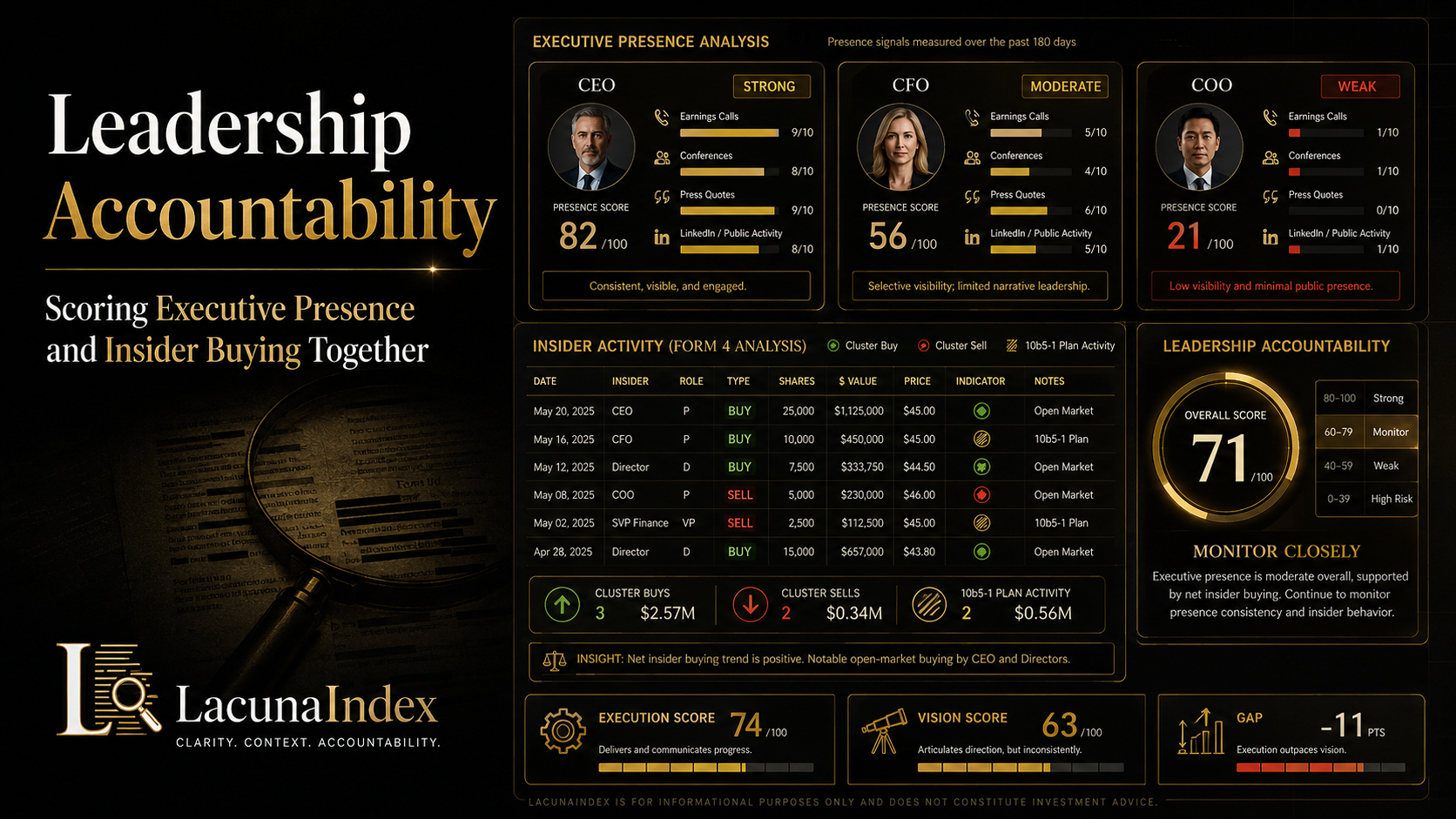
Leadership Accountability: Scoring Executive Presence and Insider Buying Together
Most diligence checklists have a line item for "management credibility," and almost no repeatable way to fill it in. You watch the earnings call, you note the tone, you move on. By the time a CFO has quietly stopped showing up to conferences or a cluster of Form 4 filings shows the C-suite selling into strength, the signal is usually already priced in — or worse, already in the post-mortem.
LacunaIndex's per-issuer reports build a named, scored check for exactly this gap, under what the platform calls Leadership Accountability — one of the more specific things in the methodology worth understanding before you rely on it.
What Leadership Accountability actually checks
Inside each issuer report, named executives get evaluated on how visible and accountable they actually are in public forums. The check pulls together four observable inputs per executive:
- Earnings-call attendance (present and speaking, present and silent, or absent)
- Analyst/investor conference appearances
- On-the-record press quotes
- LinkedIn / public professional activity
These roll into a pass/fail-style read per executive — the platform's worked methodology example (using its fictional demo issuer "ACME," not a real company) shows an executive clearing the bar with a plain, direct result. The point isn't sentiment analysis on what an executive says. It's a presence audit: is this person still standing in front of investors and putting their name on the record, or have they receded into press releases and prepared remarks read by someone else.
Why it's paired with Form 4 data, not standalone
Presence alone is a soft signal — plenty of legitimately fine executives skip a conference for reasons that have nothing to do with the business. LacunaIndex cross-references the presence check against real insider-activity data sourced from SEC Form 4 filings: net buy/sell dollar amounts, whether a sale falls under a pre-arranged Rule 10b5-1 plan, and whether multiple insiders are selling in the same window (cluster-sell detection) or buying together (cluster-buy).
That pairing is the actual diligence value. A quiet quarter from a CFO combined with scheduled, plan-based selling is very different from a quiet quarter combined with an unscheduled cluster of open-market sales from three named executives in the same two weeks. The Leadership Accountability read and the insider-activity read are separate data points in the report payload, but they're designed to be read together — presence tells you who's engaging, Form 4 clustering tells you what they're doing with their own stock while they do (or don't) engage.
Both feed into the report's broader executive-accountability and succession-readiness scoring, which sits alongside the platform's other named dimensions — financial delivery, narrative honesty, AI credibility, client validation, and eleven others — that roll up into the two headline numbers on every report: an Execution score and a Vision score, and the gap between them. A widening gap gets flagged into one of four zones, from "Aligned" up through "Narrative Danger," and a persistent gap paired with a weak Leadership Accountability read on a key executive is a different, more actionable flag than either signal alone.
Why we're comfortable naming the mechanism
A fair objection to any AI-generated scoring product is that the scores are a black box dressed up as rigor. LacunaIndex's reports carry a governance_log alongside the scores — a rule-by-rule record of every instance where a deterministic cap overrode what the underlying model wanted to output, with the original score, the cap applied, and the stated reason. Every dimension also carries its own provenance: the candidate score the model proposed, the final score after caps, and the prior report's score for the same dimension, so drift is visible rather than smoothed over. Leadership Accountability and insider-cluster detection are two of the more legible, rule-based checks in that pipeline — they don't require trusting a language model's judgment call, only its ability to correctly read a call transcript, a conference agenda, and a Form 4 filing.
Where to look before you rely on it
The full methodology, including a worked example of how the Leadership Accountability and insider-activity read show up in a report, is documented at /methodology and /methodology/issuer/{ticker} using the platform's fictional demo issuers — useful for seeing the mechanics without needing a paid subscription. Sector and cohort-level valuation benchmarks are free at /benchmarks; the full per-issuer report, including the executive-level Leadership Accountability and insider-activity detail, sits behind a paid subscription for individual names.
If you're building a pre-screen checklist for a new position, the practical takeaway is narrow and testable: pull the Leadership Accountability read and the insider-cluster flag for every named executive before you finalize a thesis, not after the next print makes the absence obvious in hindsight.
— LacunaIndex Team